Electronics
Having or operating with components such as microchips and transistors that control and direct electric currents.
What Are Semiconductors?
Semiconductors are a solid substance that has a conductivity between that of an insulator and that of most metals.
The three most frequent semiconductors used are made of Germanium (Ge), Silicon (Si), and Gallium Arsenide (GaAs).
Germanium was the first material used in diodes and transistors.
In 1954, the first Silicon transistor was introduced, it had the capabilities of the Germanium transistor, but with improved temperature sensitivity, allowing for it to work for extended periods of time without reaching higher temperatures.
In the 70’s, the first Gallium Arsenide transistor was used. This semiconductor was used primarily as it was much more suitable for its high speed and efficiency.
Doping
Doping is the process of adding a small impurity to a pure semiconductor to change its electrical properties. Lightly and moderately doped semiconductors are called extrinsic. A semiconductor doped to such high levels that it acts more like a conductor than a semiconductor is referred to as degenerate. Most semiconductors are made out of silicon crystals. Pure silicon has little use but doped silicon is the basis for most semiconductors.
Intrinsic semiconductors are not usually particular good to use in electronics. Therefore, to enhance its charge carrier concentration or conductivity intrinsic semiconductors are exposed to a process called Doping
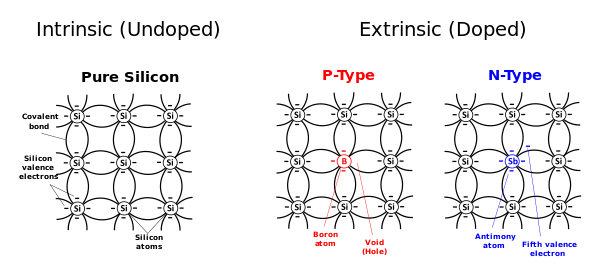
In doping, known impurities are added to the crystalline structure. If impurity is a material from Group III in the periodic table (known as the trivalent) - 3 electrons in the valance band hole concentration in the lattice increase. These impurities are called acceptors.
If the impurity is a material from Group V (known as the pentavalent), free electron concentration in the lattice increase. These impurities are called donors.