Let X and Y be subsets of R. A function f:X→Y is a rule which assigns to every element x∈Xexactly one element f(x)∈Y called the value of f at x. Here X is called the domain of f and
f(X)={f(x)∣x∈X}
is called the range of f, also written range(f).
The range of f, f(X), is a subset of Y. The range is the set of all possible values of f(x) as x varies throughout the domain. Note that f(X) is not necessarily equal to all of Y.
An exponential function is one of the form f(x)=ax, where the basea us a positive constant, and x is said to be the exponent or power. One very common exponential function which we shall see often in this course is given by f(x)=ex. It cuts the y−axis at y=1.
A function f:X→Y is said to be one-to-one or injective if ∀x1,x2∈X.
On the graph of f, the 1-1 property holds exactly if any horizontal line y= constant cuts through the curve in at most one place.
If one x corresponds to another x, then it is not one-to-one. Similarly, if y corresponds to another y of the same value, then the function is not one-to-one.
Then this is not a one-to-one function. This is because it does pass the vertical line test (with one x corresponding to one x only), but it does not pass the horizontal line test (for example, x=2∩x=−2 yield the same y value (with y=7)).
The function y=sinx is 1-1 if we just define it over the interval [2π,2π]. The inverse function for this part of sinx is denoted arcsinx. Thus arcsinx is defined on the interval [−1,1] and takes values in the range [−2π,2π]. The graph can easily be obtained by reflecting the graph of sinx about the line y=x over the appropriate interval.
Similarly y=cosx is 1-1 on the interval [0,π] and its inverse function is denoted arccosx. The function arccosx is defined on [−1,1] and takes values in the range [0,π].
Also, tan is 1-1 on the open interval (−2π,2π) with inverse function denoted by arctanx. Hence arctan has the domain (−∞,∞) with values in the range (−2π,2π).
More formally, a sequence is a function, with domain being {0,1,2,3,…}. We can also take the domain as {1,2,3,…} and start the sequence at a1 rather than a0.
If a:{0,1,2,…}→R is a function, viewed as a sequence, then we write a0 instead of a(0), a1 instead of a(1), etc.
As an approaches ℓ, n gets larger and larger. an is always close to ℓ for n sufficiently large.
3.3.1 Convention
If a sequence {an}n=0∞ has limit ℓ∈R, we say that anconverges to ℓ and that the sequence {an}n=0∞ is convergent. Otherwise the sequence is divergent.
The following limit laws apply provided that the separate limits exist (that is {an} and {bn} are convergent):
Suppose that {an} and {bn} are convergent sequences such that
n→∞liman=ℓ and n→∞limbn=m
and c is a constant. Then
n→∞lim(an±bn)n→∞limcann→∞lim(anbn)n→∞limbnan=ℓ±m;=cℓ;=ℓm;=mℓLink to original
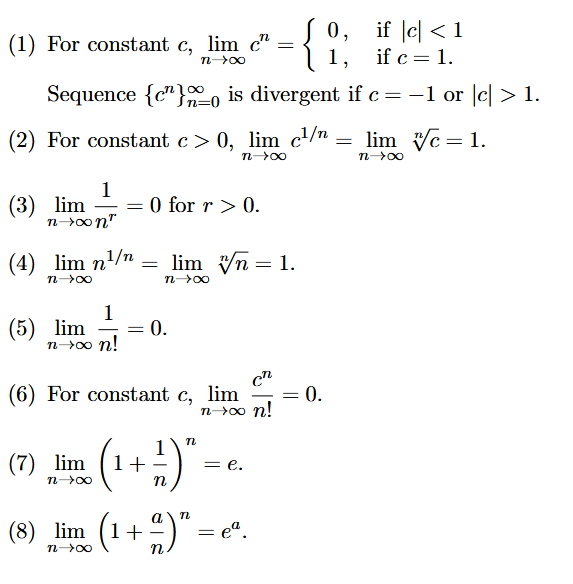
3.5 Useful Sequences to Remember
Take care with inequalities and limits. For example n1>0 for all n but limn→∞n1=0. In general, even if an>bn for all n, we can only conclude limn→∞an≥limn→∞bn. Note the ≥.
(Stewart, p.50) Let f(x) be a function and ℓ∈R. We say f(x)approaches the limit ℓ (or converges to the limit ℓ) as x approaches a if we can make the value of f(x) arbitrarily close to ℓ (as close to ℓ as we like) by taking x to be sufficiently close to a but not equal to a.
We write
x→alimf(x)=ℓ
Roughly speaking, f(x) is close to ℓ for all x values sufficiently close to a, with x=a. The limit “predicts” what should happen at x=a by looking at x values close to but not equal to a.
The following limits are fundamental. We omit the proofs. Combined with the properties given in 4.2 Properties and the Squeeze Principle in 4.4, these will enable you to compute a range of other limits.
We say that f is differentiable at some point x if this limit exists. Further, we say that f is differentiable on an open interval if it is differentiable at every point in the interval. Note that f′(a) is the slope of the tangent line to the graph of y=f(x) at x=a.
We have thus defined a new function f′, called the derivative of f. Sometimes we use the Leibniz notation dxdy or dxdf in place of f′(x).
Note that if f is differentiable at a, there holds:
f′(a)=x→alimx−af(x)−f(a)
6.2.1 Example
Using the definition of the derivative (“from first principles”), find the derivative of f(x)=x2+x.
Using the definition for a derivative, we find:
f′(x)=h→0limhf(x+h)−f(x)=h→0limh(x+h)2+(x+h)−(x2+x)=h→0limhx2+2xh+h2+x+h−x2−x=h→0limh2xh+h2+h=h→0lim(2x+h+1)=2x+1Link to original
6.5 Derivative of an Inverse Function
Suppose y=f−1(x), where f−1 is the inverse of f. To obtain dxdy we use
x=f(f−1(x))=f(y)
Differentiating both sides with respect to x using the chain rule gives:
Sometimes L’Hopital’s rule can be used to evaluate limits of sequences. Let f be a function on the real numbers such that limx→∞f(x) exists. Let f(n)=an for natural numbers n. Then:
n→∞liman=x→∞limf(x)
6.7.1 Example
Evaluate limn→∞nlnx.
Define f(x)=xlnx. Hence
x→∞limf(x)=x→∞limxlnx=x→∞lim11/x by L’Hopital’s rule⟹n→∞limnlnn=0Link to original
6.8 The Mean Value Theorem (MVT)
Let f be continuous on [a,b] and differentiable on (a,b). Then
b−af(b)−f(a)=f′(c)
for some c, where a<c<b.
Note f′(c) is the slope of y=f(x) at x=c and b−af(b)−f(a) is the slope of the chord joining A=(a,f(a)) to B=(b,f(b)).
Suppose that f is continuous on [a,b] and differentiable on (a,b).
8.4 Critical Points and Curve Sketching
A function f has a global maximum at c if f(c)≥f(x) for all x in the domain of f. The number f(c) is called the maximum value of f on its domain. A global maximum is also called an absolute maximum.
A function f has a global minimum at c if if f(c)≤f(x) for all x in the domain of f. The number f(c) is called the minimum value of f on its domain. A global minimum is also called an absolute minimum.
A function f has a local maximum at c if f(c)≥f(x) for all x near c.
A function f has a local minimum at c if f(c)≤f(x) for all x near c.
If f has a local maximum or minimum at a, and if f′(a) exists, then f′(a)=0. The point (a,f(a)) is a critical point of the function f if f′(a)=0 or if f′(a) does not exists (but f(a) does).
Thus, all local maxima and minima are critical points. Note however, that not all critical points are local maxima or minima.
To find any local maximum or minimum of a function f, we solve the equation f′=0. We can then classify any critical points we find using the information about the function near the critical point.
A function f is strictly increasing on an interval [a,b] if for all x1 and x2 in [a,b],f(x1)<f(x2) whenever x1<x2.
If f′(x)>0 on an interval, then f is strictly increasing on that interval.
If f′(x)<0 on an interval, then f is strictly decreasing on that interval.
If f′(x)=0 on an interval, then f is constant on that interval.
First Derivative Test
Suppose that the function f has a critical point at x=c. Then
If f′ changes sign from positive to negative at c, then f has a local maximum at c.
If f′ changes sign from negative to positive at c, then f has a local minimum at c.
If f′ does not change sign at c, then f has neither a local maximum nor a local minimum at c.
The Second Derivative
The second derivative of a function f is the derivative of the derived function f′. The second derivative of f is denoted f".
The second derivative provides information about the concavity of the graph of a function.
If the graph of f lies above all of its tangent lines on an interval, then it is concave up on that interval. If the graph of f lies below all of its tangent lines on an interval, then it is concave down on that interval.
If f"(x)>0 for all x in an interval, then the graph of f is concave up on that interval. If f"(x)<0 for all x in an interval, then the graph of f is concave down on that interval.
Second Derivative Test
Suppose f" is a continuous function near a point c.
If f′(c)=0 and f"(c)>0, then f has a local minimum (concave up) at c.
If f′(c)=0 and f"(c)<0, then f has a local maximum (concave down) at c.
If f"(c)=0, then this test is inconclusive.
Curve Sketching
To sketch the curve of a function y=f(x):
Determine the domain of f.
Determine the y-intercept of the graph by evaluating f(0).
If it is possible to solve the equation f(x)=0, find the x-intercepts of the graph.
Determine f′ and identify the intervals of which f is increasing and the intervals on which f is decreasing.
Find the critical points of f. Determine which critical points are local maxima or local minima (use first or second derivative test).
Determine f" and identify the intervals on which f is concave up and the intervals on which f is concave down.