— date: 03-07-2023 type: Lecture subject: MATH1051 tags: lecture Topic::
Chapter 1 - Complex Numbers
Lecture Notes 2008
1 Complex Numbers
1.1 - Notation
The symbol means “is an element of”. Thus we write:
to mean is an element of . That is, is a real number. Hence, we can write, for example, , and so forth.
1.2 - Complex Numbers
Complex numbers were introduced in the 16th century to obtain roots of polynomial equations. A complex number is of the form
where and is (formally) a symbol satisfying . The quantity is called the real part of and is called the imaginary part of . The set of all complex numbers is denoted . Thus .
1.2.1 Example
The real part of is and the imaginary part is (not ). Complex numbers can be added and multiplied by replacing everywhere with . For example .
1.2.2 Example
Simplify .
1.2.3 Example
Suppose . Simplify .
1.2.4 Example
Simplify .
It is a fact if we consider complex roots of polynomials and count them with their correct multiplicity, then a polynomial of degree always has roots. For example, every quadratic has two roots.
1.2.5 Example
Find the roots of .
Alternatively use the quadratic formula:
1.3 Polar Form
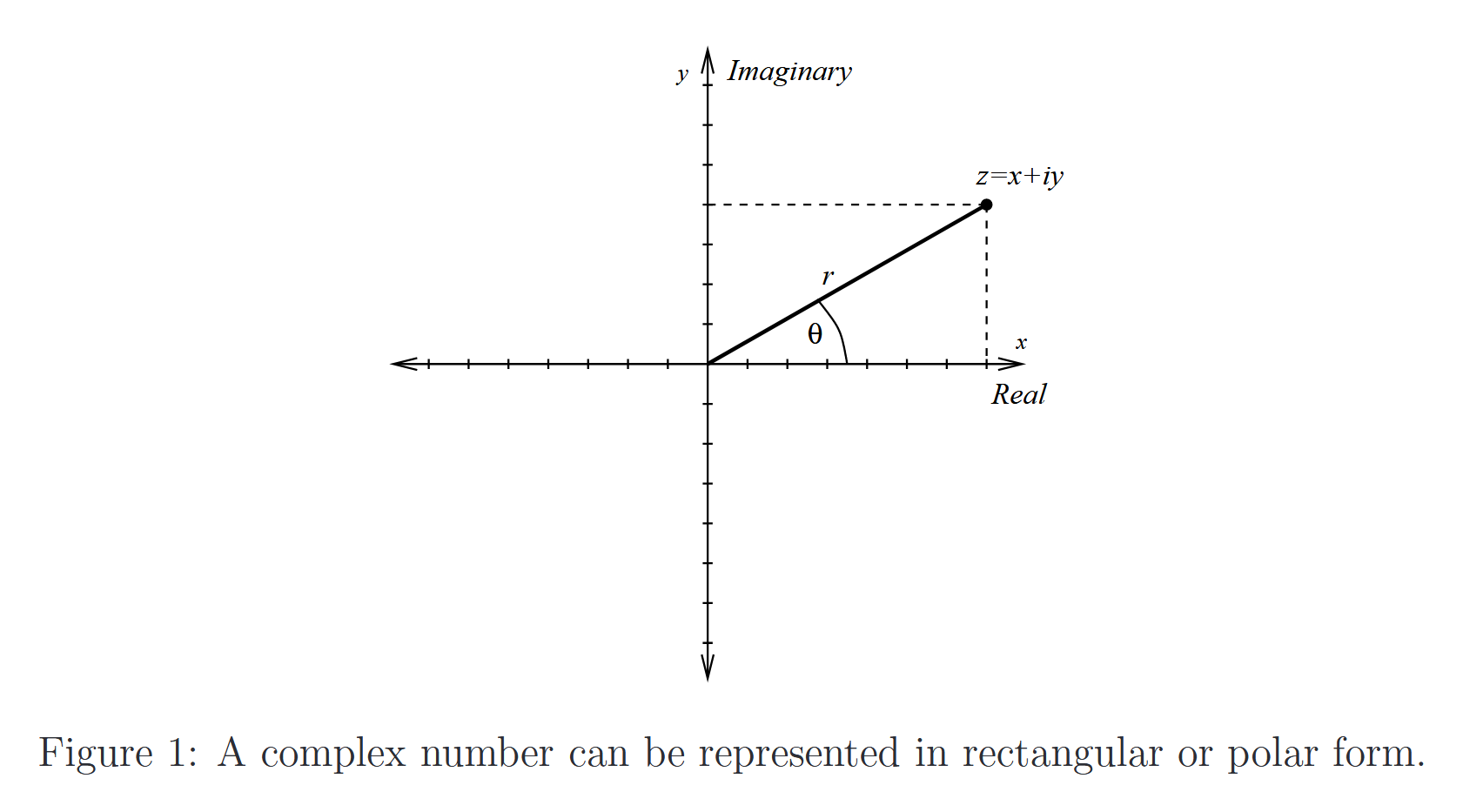
A complex number may be represented by a point in the complex plane where the vertical axis is the imaginary axis and the horizontal axis is the real axis.
We can also specify by giving the length and the angle in figure 1. The quantity is called the modulus of , denoted . It measures the distance of from the origin. The angle is called the argument of . We have:
1.3.1 Example
Write in polar form. First find the modulus:
We have for the argument , so we can take
1.4 Euler’s Formula
Euler’s formula states for any real number :
(To make sense of this, one has to define the exponential function for complex arguments. This may be done using a series.) Thus every complex number can be represented in polar form