Chapter 6 - Equations of Lines and Planes
In Chapters 2 and 3, we learned about vectors and how to use them to solve problems in physics and engineering. In this chapter, we use vectors to describe lines and planes in space.
6.1 Scalar Equation for a Plane
The equation of a plane can be expressed using scalars or vectors. In this section we will sketch planes in and determine their scalar equations.
6.1.1 Horizontal Planes
The and axes lie in the horizontal plane . All other horizontal planes are parallel to and are given by the equation .
6.1.2 Vertical Planes
A vertical plane has the form : it depends of and only and does not appear. If you are not told this is an equation of a plane, or, equivalently, an equation in , then you cannot distinguish it from the equation of a line in .
6.1.3 Arbitrary Planes
The general equation of a plane in is given by:
with fixed real numbers, If the plane is not vertical, i.e., , this equation can be rearranged so that is expressed in terms of and :
The easiest way to sketch the plane by hand is to use the triangle method: If all of the plane intercepts each axis at precisely one point. These three points make up a triangle which fixes the plane.
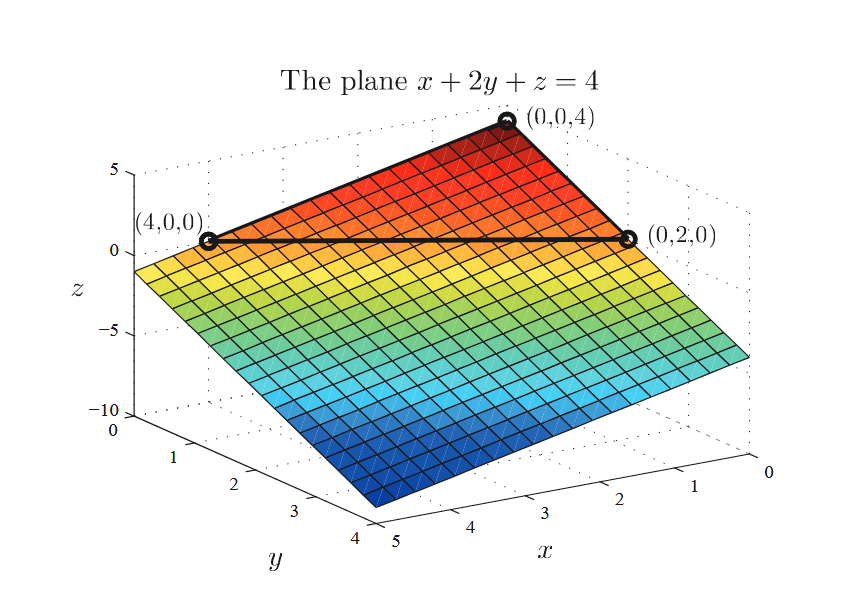
The triangle method is based on the simple fact that any three points that lie in a plane uniquely determine this plane provided these three points do not lie on a single straight line.
Note
It is customary to say the equation of a plane, even though it is not unique. Multiplying the equation of a plane by a nonzero constant gives another equation for the same plane. For example, and are equations of the same plane.
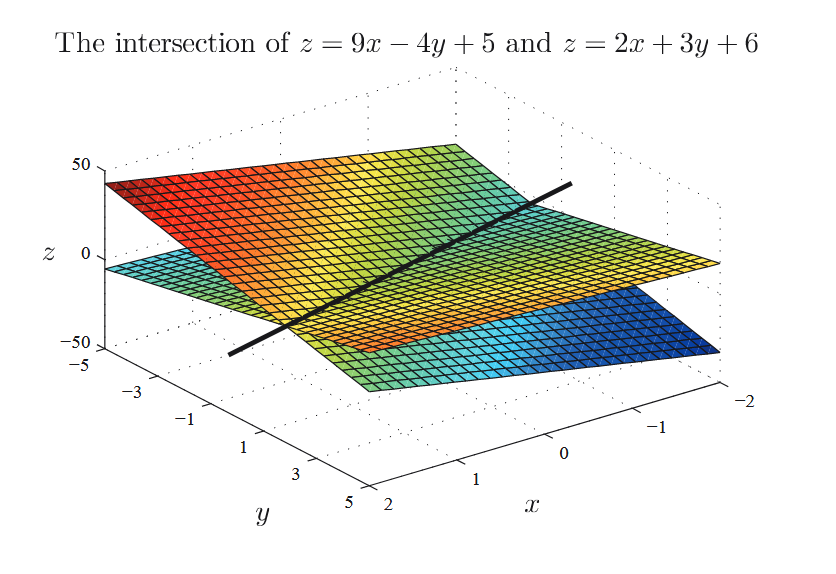
The following picture shows the intersection of the planes and . Note that the intersection is a line.
6.2 Vector Equation of a Plane I
We have seen in section 6.1 that any three points in which do not lie on a straight line determine a plane. A plane can also be specified by a point in the plane and a vector which is perpendicular to the plane.
Let be an arbitrary point in the plane. Let and be the position vectors of and respectively. Then . Since is perpendicular to ,
Hence
This is the vector equation for a plane.
The vector and scalar equations are in fact the same, as shown next.
We start with the vector equation, where is a normal, and . Then
where .
Important Remark
Given a plane we now have a geometric interpretation of the vector : it is a normal to the plane. Obviously the normal is not unique since any vector of the form , where is nonzero scalar, is also a normal.
Given a plane in a vector equation:
Example 6.2.1
Find the vector and scalar equations for the plane passing through the point with normal .
Our understanding of normal vectors allows us to compute angles between planes.
Example 6.2.2
Find the angle between the planes and .
Angle between the two planes is the same as the angle between the two normal vectors. To find the angle between the two vectors:
Important Remark
Contrary to popular belief, the angle between two planes cannot exceed .
6.3 Equations for a line
There are three common ways to represent a line:
- the vector representation;
- the parametric representation;
- the symmetric equations, obtained by eliminating parameters in 2.
The representation that is best depends on the particular problem at hand.
Important Remark
As with the equation of a plane, the vector equation of a line is not unique. One can choose any point on the line as “starting point” and one can multiply the vector by any non-zero constant.
Example 6.3.1
Find:
- The vector representation of the line passing through and parallel to the vector .
- The vector representation of the line passing through and parallel to the vector . What is the relation between the two lines?
Example 6.3.2
Find the parametric equations for the line passing through and parallel to .
Symmetric Equations
The parameter can be eliminated from the parametric equations of a line. For example, by eliminating from each of the three equations for the line , we obtain:
The equations
are known as the symmetric equations of .
What these equations really are is a set of two non-identical, non-parallel planes.
Parallel and Orthogonal Lines
Two lines are parallel if, when written as , and , the direction of vectors and are linear multiples of each other, i.e., for some nonzero scalar .
Two lines are orthogonal if their direction vectors are orthogonal. An easy test for orthogonality is to take the dot product of the direction vectors if and only if this gives zero are the lines orthogonal.
6.4 Vector Equation of a Plane Ii
There is a second type of vector equation of a plane, which is similar in form to the vector equation of a line. One fixes a point on the plane with corresponding position vector , but now not one, but two (non-parallel) vectors and parallel to the plane are required to fully determine the plane:
Important Remark
In some sense the above vector equation of a plane is even less unique than the vector equation of a line. Again one can take to be any point on the plane and one can multiply both and by non-zero constants. But unlike a line, we can also replace and by an other pair of independent vectors parallel to the plane. For example, and are different vector representations of the same plane.
6.4.1 Distance from a point to a Plane
A common problem that arises in applications is to find the distance from a point to a plane, where, by distance, we always mean minimum distance.